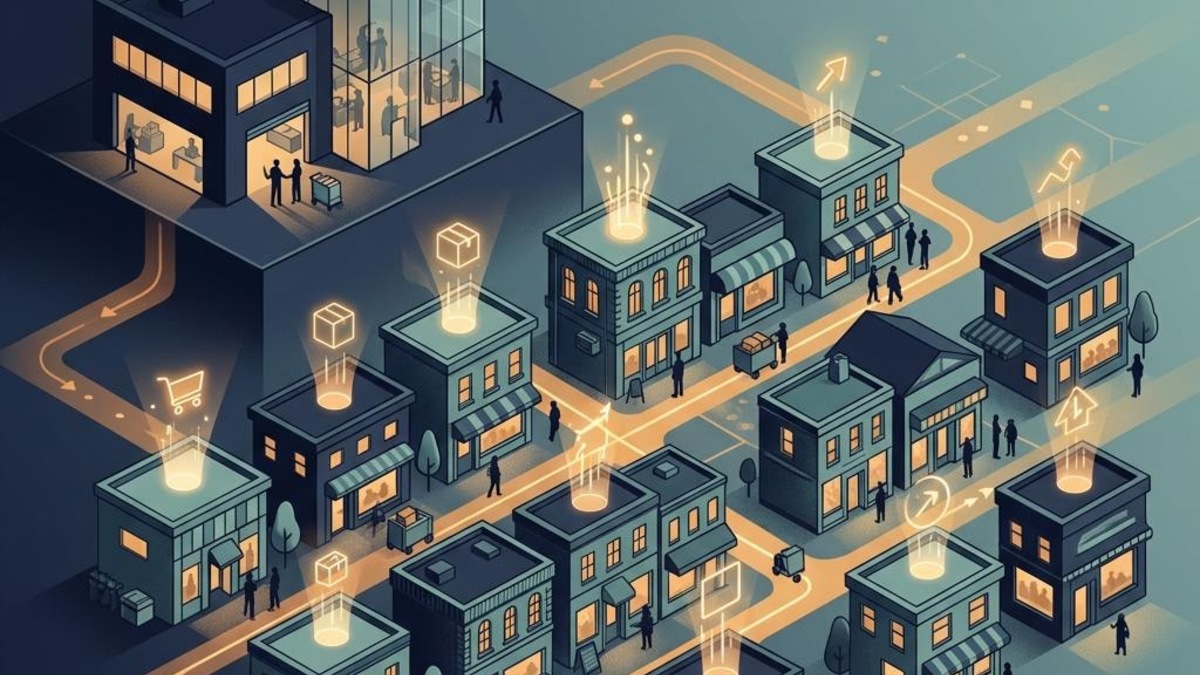
You're not going to fire your distributor tomorrow.
We know that. You know that. And anyone telling you to rip out your existing channel overnight either doesn't understand your business or doesn't have to live with the consequences.
But here's the thing most manufacturers won't say out loud: staying 100% dependent on your current distribution model isn't a strategy. It's inertia. And inertia has a cost, one that compounds every quarter you don't address it.
The real question isn't whether to explore direct-to-retail. It's how to do it without blowing up the relationships, logistics, and revenue streams you've spent years building.
That's what a hybrid distribution strategy is for.
What "Hybrid" Actually Means
A hybrid distribution model is exactly what it sounds like: you maintain your existing wholesale and distributor relationships while simultaneously opening a direct channel to retailers. You run both in parallel. You use each for what it does best.
This isn't a new concept. Nike ran a hybrid model for over a decade, growing direct-to-consumer sales from 16% of brand revenue in 2011 to nearly 44% by 2023, while still generating billions through wholesale. Apple sells through its own stores and through Best Buy. Procter & Gamble ships through distributors and sells direct on its own platforms.
The pattern is the same across industries: manufacturers are adding direct channels not to eliminate intermediaries, but to create optionality.
In the firearms and outdoor industry, the math is even more compelling. Distributors typically operate at margins between 27% and 33% of the retail price, margin that comes directly out of the manufacturer's pocket. When a manufacturer ships through a distributor, that distributor takes their cut, the dealer takes theirs, and the manufacturer is left with the narrowest slice of a transaction involving their own product.
A hybrid model doesn't ask you to forfeit the reach and convenience of distribution. It asks you to stop paying full freight on every single order when some of those orders don't require a middleman at all.
Why Not Just Go Fully Direct?
Because Nike tried that, and it didn't work the way they planned.
Between 2017 and 2023, Nike aggressively cut wholesale partners, dropping relationships with retailers like Zappos, Urban Outfitters, and Dillard's, to push consumers toward Nike.com and Nike-owned stores. Early results looked promising. Direct revenue climbed. Margins improved. The strategy seemed validated.
Then the cracks appeared. When consumer spending softened, Nike didn't have enough third-party retail presence to move inventory. Competitors filled the shelf space Nike had voluntarily surrendered. By 2024, Nike's own CEO acknowledged the company had added "complexity and inefficiency" and needed to re-invest in wholesale partnerships.
The lesson isn't that direct sales are bad. The lesson is that going all-in on any single channel creates fragility. Wholesale gives you reach and volume. Direct gives you margin and data. A manufacturer that has both is more resilient than one that has either alone.
For firearms manufacturers specifically, the wholesale channel serves functions that can't be easily replaced overnight. Distributors aggregate demand across thousands of dealers. They extend credit. They warehouse product. They handle much of the logistical complexity of getting firearms from your loading dock to a dealer's shelf.
The goal of a hybrid strategy isn't to replicate all of that. It's to identify the transactions where distributor involvement adds cost without adding proportional value, and route those differently.
Where Direct Makes Sense First
Not every order needs to go through a distributor. Some orders are simple, predictable, and large enough that the manufacturer can fulfill them directly without meaningful added cost. Those are your starting point.
High-volume dealer relationships. If you have dealers ordering in consistent, predictable quantities, the distributor's role in that transaction is largely logistical. You're paying 27-33% for someone to receive your product, put it on a shelf, and ship it to a dealer you already know by name. The credit risk is established. The demand is proven. The distributor is collecting margin for routing, not for value creation.
New product launches. When you release a new SKU, your distributor decides how to position it, which dealers see it first, and how much inventory to allocate. You lose control of the single most important moment in your product's lifecycle. A direct channel lets you place new products with your best-performing dealers on your timeline, with your messaging, and with your margin intact.
MAP-sensitive products. If MAP enforcement is a concern (and if you've been in this industry for more than a year, it is), a direct channel gives you structural enforcement. When you control the transaction, you control the price. You don't have to wonder which distributor is offering side deals that undercut your policy.
Geographic or segment targeting. Distributors optimize for their own portfolio, not yours. If you want to push into a new region or retail segment, you're dependent on your distributor's priorities aligning with yours. A direct channel lets you make those decisions independently.
Managing Channel Conflict
Let's address the elephant in the room. If you open a direct channel, your distributor will notice. And they probably won't be thrilled.
Channel conflict is real. It's the most common objection manufacturers raise when direct-to-retail comes up. But it's also the most overblown.
Here's why: channel conflict is only destructive when it's handled poorly. When it's managed deliberately, the research consistently shows that adding a direct channel can increase total channel sales rather than cannibalize them. The reason is straightforward: a direct channel reaches transactions that weren't happening through the distributor anyway, or that were happening at artificially depressed margins.
The manufacturers who manage this well tend to follow a few principles:
Transparency over secrecy. Don't launch a direct channel and hope your distributor doesn't notice. That's how you turn a business decision into a betrayal narrative. Communicate clearly: "We're opening a direct channel for specific use cases. Here's what changes and what doesn't."
Segmentation over competition. Define which dealers or order types route through which channel. Your distributor keeps the long tail of small dealers who order irregularly and need credit terms. Your direct channel handles the high-volume accounts where the economics justify it. Each channel has a defined role.
Pricing discipline. The fastest way to create genuine conflict is to undercut your distributor on price. MAP policies, consistent wholesale pricing, and clear channel-specific terms prevent the kind of price arbitrage that poisons relationships.
Data sharing. One of the biggest concerns distributors have is being blindsided. Sharing sell-through data, demand signals, and inventory positions across both channels reduces the information asymmetry that breeds mistrust.
None of this is theoretical. Industries from electrical supply to CPG to sporting goods have navigated this transition. The pattern is well-established. What's different in firearms is that the industry has been slower to modernize, which means the first movers have an outsized advantage.
The Data Argument
There's a dimension to this that goes beyond margin improvement, and it's the one most manufacturers underestimate: data.
When your product moves through a distributor, you know you shipped 500 units to a warehouse. You may know which dealers those units eventually reached. But you almost certainly don't know how long they sat in the distributor's inventory. You don't know whether Dealer A sold through in a week while Dealer B hasn't moved a unit in three months. You don't know which SKUs are actually driving reorders versus which ones are gathering dust.
A direct channel gives you that visibility. You see the order, the dealer, the frequency, the volume, the product mix, and the timing. Over months, that data becomes a strategic asset. It tells you where demand is real, which products need attention, and which dealer relationships are worth investing in.
That's not a nice-to-have. In an industry where inventory decisions are made on gut feeling and distributor anecdotes, real transaction data is a competitive weapon.
Getting Started Without Getting Burned
If you're considering a hybrid approach, the practical path forward is incremental, not revolutionary.
Start with a handful of your strongest dealer relationships, the ones where you already have direct communication, established trust, and consistent order patterns. Route those orders through a direct channel. Measure the results: margin improvement, fulfillment speed, dealer satisfaction, data quality.
Keep your distributor relationships intact for everything else. The long tail of dealers, the irregular orders, the accounts that need credit facilities: that's where distributors still earn their margin.
As the direct channel proves itself, expand it deliberately. Add more dealers. Add more SKUs. Build the operational muscle to handle growing volume.
The manufacturers who get this right aren't the ones who make the biggest move first. They're the ones who make the smartest move first, prove it works, and then scale from a position of evidence rather than faith.
The Cost of Waiting
The risk of a hybrid strategy is channel conflict. That's manageable, and the playbook for managing it is well-documented.
The risk of not pursuing a hybrid strategy is less obvious but more dangerous. Every year you remain fully dependent on distribution, you're paying the margin premium, losing the data, and ceding strategic control of your retail relationships to someone whose incentives don't perfectly align with yours.
You're also giving your competitors time. If another manufacturer in your category opens a direct channel before you do and can offer dealers better margin, faster fulfillment, and more product control, your distributor relationship won't protect you from that. Dealers buy what sells, from whoever makes it easiest.
A hybrid strategy isn't about being anti-distributor. It's about being pro-manufacturer. It's about building a business where you have more than one path to your customer, more than one source of margin, and more data than your competitors about what's actually happening in the market.
You don't have to fire your distributor tomorrow. But you should be building the capability to not need them for every transaction. Because the manufacturers who have that optionality will outperform the ones who don't. That's not a prediction. That's just math.
That capability also depends on choosing an architecture that can support smaller accounts. See why native EDI can stifle mid-market wholesale growth.