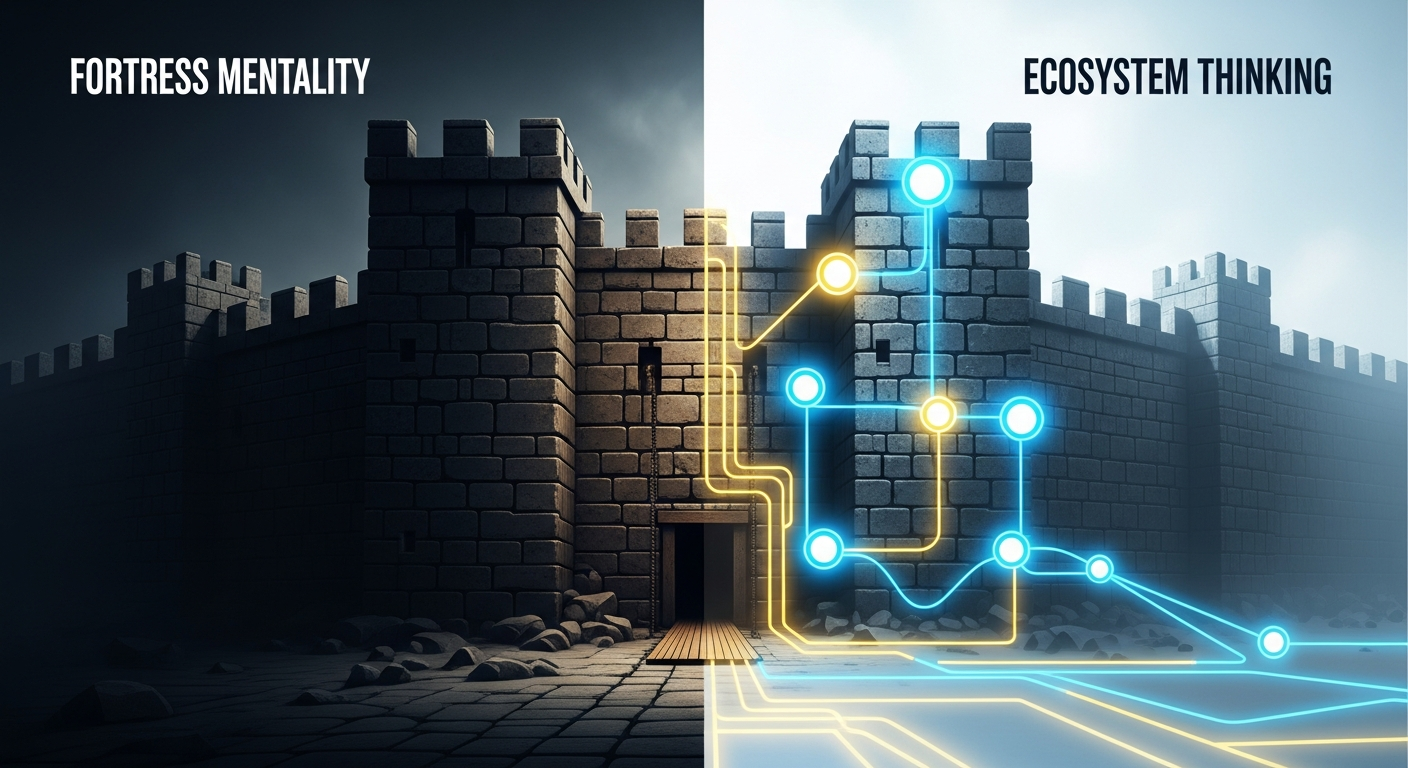
There is a prevailing instinct among manufacturers in the firearms and outdoor industry when it comes to wholesale infrastructure: build walls.
Keep your dealer data inside your own system. Keep your pricing logic in your own portal. Keep your order history in your own database. Control everything. Trust nothing outside your domain. The fortress is yours. The moat is yours. And as long as the walls hold, you are safe.
It is an understandable instinct. This industry has been burned repeatedly by platforms with misaligned values, payment processors that terminate accounts without warning, and social channels that deplatform brands overnight. Building a fortress feels like a rational response to an environment that has treated the 2A industry as a liability.
But here's the problem: the fortress is an illusion. And in most cases, it is an expensive illusion that actively limits your ability to grow your dealer network, move inventory efficiently, and compete with manufacturers who have figured out something important — that wholesale commerce is a network problem, not a wall problem.
What the Fortress Actually Looks Like
Let's be specific about what manufacturers in this industry are actually building and maintaining, because "we own our wholesale infrastructure" covers a wide range of situations, and they are not all equal.
The self-hosted open source stack. WooCommerce and Magento Open Source represent the most common version of "true ownership" in the mid-market. You host it. You maintain it. Your IT team or your agency owns the code. There are no monthly platform fees, no terms of service that can change overnight, and no landlord deciding what features you can and cannot use.
This is also where the hidden costs live. WooCommerce is built for retail. Adding genuine wholesale functionality — tiered dealer pricing, role-based catalog access, bulk ordering, account approval workflows, net terms — requires assembling a stack of third-party plugins that were not designed to work together. Wholesale Suite, WholesaleX, B2B for WooCommerce, custom payment term extensions — each one adds maintenance burden, update conflicts, and failure points. The result is a wholesale portal that is technically "owned" but practically fragile, maintained by a developer who has to be called every time two plugins release updates on the same day.
Magento (now rebranded as Adobe Commerce's open source foundation) is more capable but compounds the problem. The flexibility is real, but so is the implementation cost, the upgrade cycle risk, and the operational complexity of keeping a Magento instance current, secure, and functional. Many manufacturers running self-hosted Magento installations are essentially running software that hasn't been meaningfully updated in years, because the cost and disruption of upgrading outweighs the perceived benefit.
The data is technically yours in both cases. But the functional value of that data — your ability to surface it, act on it, share it with dealers in useful ways — is limited by infrastructure that was built to serve a retail use case and bolted into wholesale workflows after the fact.
The managed platform with a B2B module. BigCommerce B2B Edition, Shopify Plus, and their counterparts represent the next category: platforms that recognized the B2B opportunity and layered wholesale features onto fundamentally retail infrastructure. The approach varies by platform, but the architecture is similar: customer groups become "companies," customer accounts get assigned roles (buyer, approver, admin), and pricing tiers are applied at the company level. Net terms are added as a payment option. The result looks like a wholesale portal. It functions like one, mostly.
What it doesn't do is solve the network problem. Each manufacturer's B2B portal is its own island. Dealers who buy from five different manufacturers are managing five separate logins, five separate onboarding processes, five separate order histories. There is no shared language between portals, no common dealer identity, no way for a dealer to see their aggregate purchasing across vendors. And there is no mechanism for a manufacturer to discover dealers they don't already know, because the portal only serves the relationships that already exist.
The managed platform also introduces dependency risk that the self-hosted crowd correctly identifies as a problem — you just traded one set of risks for another. BigCommerce Holdings rebranded as Commerce.com in mid-2025 after replacing its entire senior leadership team, repositioning the platform around AI-driven "agentic commerce" and embedding PayPal as its preferred payment solution. PayPal's Acceptable Use Policy explicitly prohibits transactions involving firearms, ammunition, and "certain firearm parts or accessories" — a prohibition they enforce without warning and without a clear published list of what qualifies. A manufacturer who built their dealer wholesale portal inside BigCommerce's ecosystem did not choose PayPal as their payment processor. Commerce.com chose PayPal, and the manufacturer lives with that decision.
Shopify Plus carries its own version of this risk. The platform has a documented history of restricting and removing merchants in the 2A space under pressure from payment processor policies and activist groups. The "Plus" tier provides more flexibility and dedicated support. It does not provide immunity from platform-level decisions made in service of Shopify's broader investor and partner relationships.
The enterprise commerce stack. At the high end of the market, manufacturers running significant volume often end up on Adobe Commerce (the licensed, cloud-hosted successor to Magento Commerce), Salesforce Commerce Cloud, or NetSuite's commerce modules — sometimes in combination. Adobe Commerce licenses start around $24,000 per year and scale into six figures for enterprise deployments. Salesforce Commerce Cloud is priced similarly, with implementation costs from a certified partner typically running $200,000 to $500,000 or more before the first dealer logs in.
What these platforms offer is genuine enterprise-grade infrastructure: multi-storefront management, deep ERP integration, sophisticated quote and approval workflows, role-based catalog management, and the kind of reliability that comes with a large engineering team behind the product. What they do not offer is anything resembling purpose-built wholesale infrastructure for the firearms and outdoor industry. You are paying enterprise prices for a general-purpose commerce engine that you will spend significant additional resources customizing to fit your dealer network, your compliance requirements, and your industry-specific workflows. The ERP integration alone — getting your NetSuite or SAP instance talking cleanly to your dealer-facing portal in real time — is a multi-month implementation project.
And none of it — not WooCommerce, not Magento, not Adobe Commerce, not Salesforce Commerce Cloud — does anything about the network problem. Your dealers are still logging into your portal alone. Your data about dealer purchasing behavior is still siloed inside your system. The manufacturer across the aisle at SHOT Show is running their own separate fortress. And the dealer you've never heard of, who is buying your competitor's product because they don't know you exist, has no way to find you through any of it.
The Network Problem Nobody Is Solving
Here is the thing that the fortress mentality obscures: wholesale commerce in the firearms and outdoor industry is not primarily a portal problem. It is a network problem.
The traditional distribution model exists because it solved a real problem — dealers needed a way to discover and order from multiple manufacturers without maintaining individual relationships with each one. Distributors became the connective tissue of the industry. They solved the network problem.
They also extracted significant margin for doing so, imposed minimum order requirements that favored large dealers over small ones, provided manufacturers with almost no visibility into who was actually buying their product at the dealer level, and created a layer of intermediation that slowed everything down and added cost to every transaction.
The manufacturers who built their own wholesale portals were trying to escape that model. And they succeeded, partially — they established direct relationships with the dealers they already knew, cut out the distributor margin on those transactions, and gained some visibility into their own order data.
But they did not solve the network problem. They just moved it inside their own walls.
A firearms accessories manufacturer with 200 active dealer accounts has direct relationships with 200 dealers. There are tens of thousands of licensed dealers in the United States. The ones outside those 200 accounts are invisible to the manufacturer's portal, because the portal has no mechanism for discovery in either direction. A new dealer who wants to carry that manufacturer's product has to find their way to the manufacturer's website, request a dealer account, wait for approval, learn a new portal, and then repeat that process for every other manufacturer they want to work with.
That friction is not a technology problem. It is a network architecture problem. And a fortress, no matter how well-built, cannot fix it.
What Participation in a Commerce Ecosystem Actually Means
The alternative to the fortress is not giving up control. It is recognizing that your wholesale business exists inside a commerce ecosystem — an industry-wide network of manufacturers, dealers, distributors, and buyers — and choosing infrastructure that treats that ecosystem as an asset rather than a threat.
In practice, this means a few specific things.
Shared dealer identity. In a purpose-built wholesale network, a dealer who is already active on the platform brings their verified identity with them. Their FFL credentials, their business information, their purchasing history — not exposed to other manufacturers, but verified and portable. The dealer onboarding burden shifts from each manufacturer individually to the network. A manufacturer launching on the platform inherits access to a dealer community that is already there.
Bidirectional discovery. Manufacturers can be found by dealers who are actively looking for products to carry. Dealers can be found by manufacturers who are looking to expand their network into specific geographies or segments. Neither has to cold-call the other through trade shows and email campaigns alone.
Operational efficiency that compounds. When inventory sync, order routing, payment settlement, and compliance verification happen at the platform level rather than inside each manufacturer's custom-built system, the operational overhead per transaction goes down as volume goes up. A manufacturer running $2M in annual wholesale through a fragmented stack of plugins and spreadsheets is doing the same work per order at $2M that they would do at $200K. A manufacturer running through purpose-built wholesale infrastructure gets progressively more efficient as volume increases.
Data that is actually useful. Order data trapped in a single-manufacturer portal tells you about your existing relationships. Order data flowing through an industry network — even with appropriate privacy controls — tells you about dealer purchasing patterns, category trends, and demand signals across the market. That is a fundamentally different kind of intelligence.
None of this requires surrendering control of your business. It requires distinguishing between control that matters — your pricing decisions, your dealer relationships, your product catalog, your brand — and control that is really just maintenance burden disguised as ownership.
The Real Risk Is Not the Platform. It Is Isolation.
The manufacturers who are most at risk right now are not the ones on BigCommerce or Shopify. They are the ones who built a fortress in 2018 or 2020, declared victory, and stopped thinking about wholesale infrastructure as a strategic question.
Their dealer portals work. Their existing dealer accounts are active. Their order data is in their database. Everything is fine.
Until the dealer network stops growing because discovery is broken. Until a new generation of dealers defaults to buying from whoever has the best ordering experience, and the fortress portal hasn't been updated in three years. Until a competitor joins a network that brings 500 new dealer relationships as a platform-level asset, and closes the geographic gaps in their distribution overnight.
The fortress was built to protect what you have. It was never designed to help you get what you don't have yet.
That is the question worth sitting with: not whether your current infrastructure is working, but whether it is capable of doing the work that actually drives growth. Getting new dealers. Moving more product to existing dealers. Building the kind of dealer network density that makes your brand a default carry, not a considered option.
Those outcomes don't come from better walls. They come from recognizing something the fortress mentality actively resists: your business is not a standalone organism. It exists inside a dealer network, inside a supply chain, inside a market. Every manufacturer in this industry is already part of an ecosystem — the only question is whether your infrastructure reflects that reality or fights it.
The manufacturers who will define the next decade of this industry are not the ones with the most sophisticated portals. They are the ones who stopped treating their dealer network as a resource to be contained and started treating it as a system to participate in. Infrastructure that connects you to that system — that makes you easier to find, easier to order from, and easier to grow with — compounds over time in ways that a well-maintained fortress never will.
The drawbridge was never the asset. The network was.
Oryx DTR is a wholesale infrastructure platform built to connect manufacturers directly to licensed dealers — with the payment alignment, compliance tooling, and dealer network architecture that the firearms and outdoor industry actually requires. Our Store Connectivity Layer integrates with WooCommerce, Shopify, BigCommerce, and other platforms, so manufacturers who have already built something do not have to abandon it to participate in the network.
If you are evaluating your wholesale infrastructure, we would like to talk. oryxdtr.com
Sources
- Digital Commerce 360: Why BigCommerce Suddenly Changed CEOs (October 2024)
- Digital Commerce 360: BigCommerce Rebrands to Commerce.com (July 2025)
- Commerce.com Press Release: Introducing Commerce, the New Parent Brand of BigCommerce (July 31, 2025)
- PayPal/Commerce Press Release: Commerce Introduces BigCommerce Payments Powered by PayPal (October 20, 2025)
- PayPal Acceptable Use Policy (current)
- GunTab: Payment Platform Rules on Firearms (policy documentation aggregator)
- Jacob S. Paulsen: PayPal and the Gun Industry — What You Need to Know
- Net Solutions: Adobe Commerce B2B Features Guide (2026)
- Able Rabbit: Best WooCommerce Wholesale Plugins (November 2025)
- Digital Commerce 360 B2B Manufacturing Report: Manufacturer eCommerce Platform Satisfaction (2024)