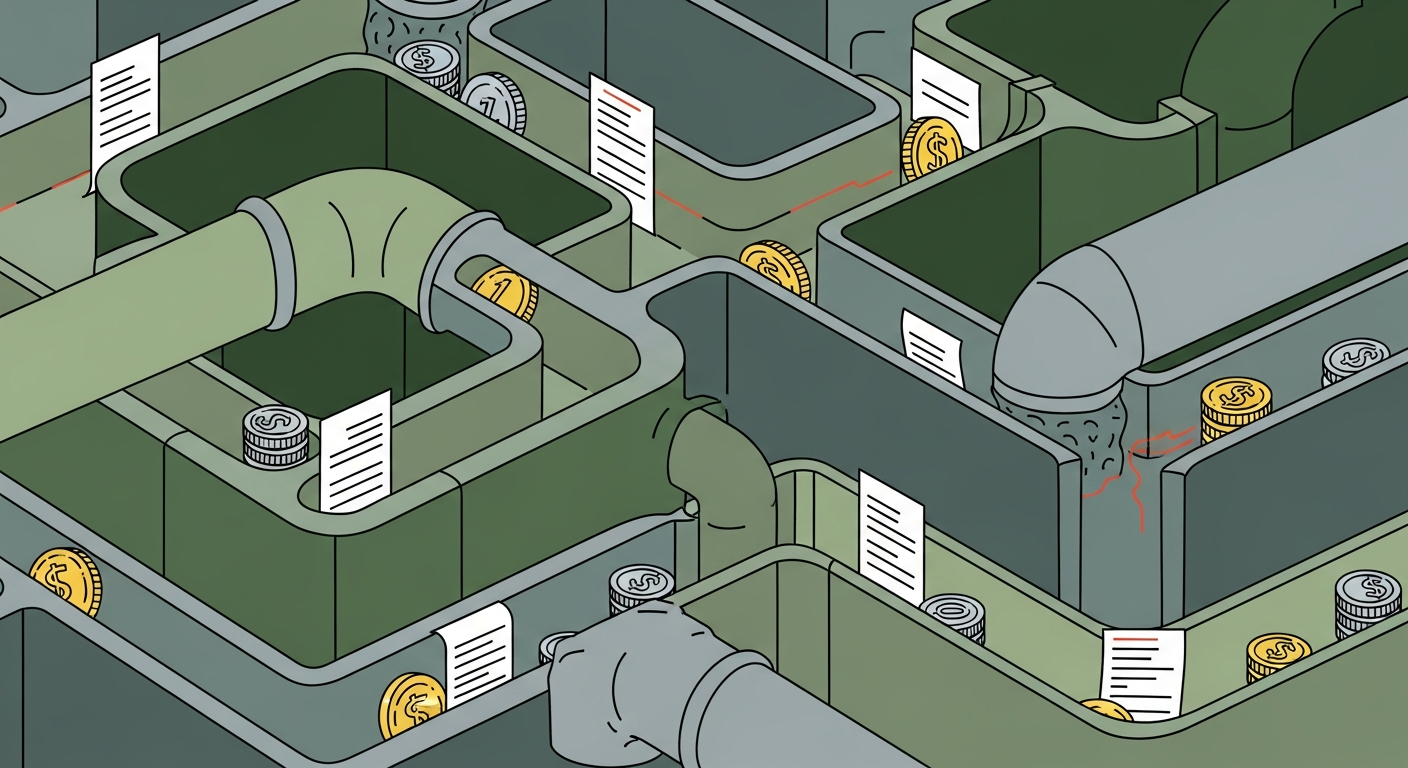
Here's something most people outside the firearms industry would never guess: the companies making the guns often have no idea which retailers are selling them, how fast they're moving, or what's sitting on shelves.
This isn't negligence. It's architecture. The way the distribution model works, data stops flowing the moment a product leaves the distributor's warehouse. From that point forward, the manufacturer is operating on estimates, inferences, and quarterly reports, while every other decision in their business depends on understanding what's actually happening at retail.
That data gap has always been expensive. But in a market that's tightening after the post-COVID surge, it's becoming something manufacturers can't afford to work around.
What Manufacturers Actually See Today
Let's start with what the data flow looks like in a typical firearms distribution model.
A manufacturer builds product and ships it to one of their wholesale distributors. For most major manufacturers, that's a pool of somewhere between 10 and 20 companies. Ruger's 10-K filing puts a specific number on it: over 90% of their sales flow through just 14 independent wholesale distributors.
At this point, the manufacturer knows exactly what they shipped, to whom, and when. That data is clean and complete. It has to be; it's the basis for revenue recognition and financial reporting.
Then the product enters the distributor's ecosystem, and the manufacturer's visibility effectively ends.
The distributor sells to dealers. Which dealers, in what quantities, at what pace: the manufacturer typically doesn't know in real time. They may get periodic reports from their distributor. If they're a large publicly traded company with leverage, they might get aggregate sell-through estimates. If they're a smaller manufacturer, they might get nothing at all beyond their own shipment data and the checks that come back.
Ruger publishes "estimated unit sell-through" from distributors to retailers in their earnings reports. In early 2024, they reported that sell-through of their products decreased 7% year-over-year, outpacing the 4% decline in adjusted NICS background checks. Their explanation for the gap: "aggressive promotions, discounts, rebates, and the extension of payment terms offered by our competitors."
Read that carefully. One of the largest firearms manufacturers in the country is estimating, not measuring, how their products move from distribution to retail. And when the estimate comes in worse than the industry benchmark, they're inferring competitive dynamics from the outside. They know what happened to their numbers. They're guessing at why.
Smith & Wesson's CFO described distributor inventory declining "over 10% from the end of the prior quarter," calling it evidence of "positive sell through of our products at retail." The manufacturer is reading distributor inventory levels as a proxy for retail demand, because they don't have a direct signal from the retail transaction itself.
These aren't small companies with unsophisticated operations. These are publicly traded manufacturers with dedicated financial teams, investor reporting requirements, and every incentive to understand their market precisely. The data gap isn't a capability problem. It's a structural one.
What the Gap Actually Costs
The cost of operating without retail-level data shows up in three places: production decisions, product strategy, and competitive response.
Production allocation. When a manufacturer can't see which SKUs are moving at retail, they're allocating production based on shipment history to distributors, which is one step removed from actual demand. If a distributor orders heavy in Q1 and then sits on inventory through Q2, the manufacturer might read that as flat demand when the real signal is that Q1 was over-ordered. They respond by cutting production on a product that might actually be selling well at retail, just not reordering yet because the channel is full.
McKinsey's 2024 retail analytics research found that companies using advanced SKU-level analytics saw 15-20% improvement in sales per SKU within the first year. A Gartner study from the same period showed that firms with predictive analytics improved inventory turnover by 12% on average. These aren't theoretical gains; they're measured outcomes from companies that have the data to act on.
Firearms manufacturers are making the same category of production decisions as any other durable goods company, but with significantly less data to support them.
Product strategy. New product introductions are some of the highest-stakes decisions a manufacturer makes. A new platform, a new caliber offering, a limited-run variant: each one requires production commitment and marketing investment before the market renders its verdict.
In the distributor model, the manufacturer learns whether a new product succeeded by watching shipment velocity to distributors and waiting for reorders. That signal is slow and noisy. A strong initial distributor order might reflect genuine dealer enthusiasm or it might reflect a distributor stocking up to have allocation available. Weak reorders might mean the product failed or might mean the distributor is still working through initial inventory.
Polestar Analytics documented a case where a consumer goods manufacturer discovered that a nationally underperforming SKU was actually a regional success in the Northeast, data that only surfaced through granular, location-specific sell-through analysis. Without it, the manufacturer would have discontinued the product entirely. The firearms industry faces the same blind spot. A new model that's sitting in Southern distributors' warehouses might be flying off shelves at dealers in the Mountain West, but without retail-level data, the manufacturer will never know.
Competitive response. Perhaps most critically, the data gap slows competitive reaction time by weeks or months. When a competitor launches an aggressive promotion, drops pricing, or introduces a compelling new product, the first manufacturers to feel the impact are the ones whose dealer sell-through declines. But if a manufacturer doesn't see sell-through data in real time, they won't detect the competitive threat until it shows up in distributor reorders, which might be 30, 60, or 90 days later.
Ruger's 2024 earnings illustrate this precisely. Their sell-through declined faster than the overall market, and they attributed it to competitor promotions and extended payment terms. But that diagnosis came after the fact, in an annual earnings report. A manufacturer with real-time retail data would have seen the sell-through deceleration in weeks, not quarters, and could have responded with targeted counter-promotions or allocation adjustments before losing significant ground.
Why Distributors Don't (and Can't) Close the Gap
It's important to understand that this isn't about distributors withholding data out of malice. The data gap is a structural feature of the business model, not a failure of any individual company.
Distributors manage relationships with dozens of manufacturers simultaneously. Their systems are optimized for their own operations: purchasing, warehousing, fulfillment, and their own sales analytics. Sharing granular, dealer-level transaction data with every manufacturer they carry would require infrastructure and processes that don't exist in most wholesale operations, and that would undermine a key part of their value proposition.
Because here's the uncomfortable truth: a distributor's information advantage is part of their competitive moat. The distributor knows which dealers are buying what, in what volumes, and how quickly. That knowledge informs their own purchasing decisions, their allocation strategies, and their negotiating leverage with manufacturers. Sharing it freely would reduce the asymmetry that makes the distributor relationship sticky.
This isn't an accusation; it's an observation about incentive structures. A distributor has no business reason to give manufacturers the data that would make it easier for those manufacturers to go around them. And a manufacturer asking for that data within the distributor relationship is asking for something that conflicts with the distributor's rational self-interest.
The result is a stable but suboptimal equilibrium: manufacturers want more data, distributors have some of it but won't share it all, and the gap persists because neither party can close it within the existing relationship structure.
What Changes When the Structure Changes
The manufacturer-to-retailer data gap isn't a technology problem. Plenty of technology exists to capture, analyze, and act on SKU-level retail transaction data. The B2B analytics industry (companies like SPS Commerce, Retail Velocity, and dozens of others) exists specifically because this data is valuable and actionable.
The problem is structural. In the firearms distribution model, the manufacturer is separated from the retail transaction by one or two intermediaries, and neither intermediary has an incentive to pass transaction-level data upstream.
The only way to close the gap is to change the structure: to create a commercial relationship between the manufacturer and the retailer that generates transaction data as a natural byproduct of doing business.
When a manufacturer receives an order directly from a dealer, they don't need a third-party analytics platform to tell them what happened. The order itself is the data point. Which dealer, which SKU, what quantity, what price, what date. Multiply that by hundreds or thousands of orders and you have a real-time picture of your market that no amount of distributor reporting can replicate.
Over time, that data compounds. Seasonal patterns become visible. Regional differences emerge. New product performance can be measured in weeks rather than quarters. Production can be adjusted based on actual demand signals rather than lagging distributor estimates. Competitive threats surface faster because sell-through deceleration is visible in real time.
None of this requires sophisticated AI or massive data science teams. It requires a direct commercial relationship between the people making the products and the people selling them. The analytics follow naturally from the transaction.
The Gap Is Widening
Every other B2B industry has been moving toward transaction-level data visibility for years. Consumer packaged goods companies track sell-through at the store and SKU level. Automotive parts manufacturers have real-time dealer ordering data. Even traditional wholesale industries like plumbing and electrical supply have migrated to platforms that give manufacturers visibility into what's moving at the point of sale.
The firearms industry has been insulated from this shift, partly by the concentrated distributor structure and partly by the unique regulatory environment that makes any kind of data sharing feel fraught. But the underlying economics are the same: manufacturers who can see their market in real time make better decisions than manufacturers who can't.
Harvard Business Review research found that 70% of customers who encounter a stockout buy from a competitor. In firearms retail, where brand loyalty is real but patience for availability is limited, every missed allocation signal is a potential lost relationship, not just a lost sale. The 2024 Federal Reserve Payments Study found that 92% of businesses are prioritizing improved cash flow, and real-time transaction visibility is the foundation on which better cash flow management is built.
The manufacturers who recognize this gap, and take steps to close it, will have a structural advantage that compounds over time. Better data leads to better decisions. Better decisions lead to better products reaching the right dealers at the right time. And that leads to the kind of market position that's very difficult for competitors to replicate once it's established.
The data is out there. It's being generated every day at the point of sale. The question is whether it reaches the people who need it most.
Sources
- Sturm, Ruger & Co., 2024 10-K Annual Report, SEC Filing (90%+ sales through 14 distributors, estimated sell-through methodology)
- Sturm, Ruger & Co., February 2024 Earnings Release (7% sell-through decline vs. 4% adjusted NICS decrease, competitor promotion attribution)
- Smith & Wesson Brands, Q1 FY2026 Earnings Release, September 2025 (CFO Deana McPherson on distributor inventory as sell-through proxy)
- McKinsey & Company, 2024 Retail Analytics Survey (15–20% sales-per-SKU improvement with advanced analytics)
- Gartner, 2024 Predictive Analytics Report (12% inventory turnover improvement with predictive analytics)
- Polestar Analytics, "Connecting Suppliers, Distributors & Retailers with Data Analytics" (regional SKU performance discovery case study)
- Harvard Business Review, Inventory Transparency Research (70% competitor switching rate after stockout)
- Federal Reserve Payments Improvement, 2024 Business Payments Study (92% of businesses prioritizing cash flow improvement)
- SPS Commerce / Retail Velocity, sell-through analytics platform documentation (SKU-level data capabilities, CPG manufacturer testimonials)
- The Smoking Gun / Giffords, firearms distribution chain analysis (Ruger's stated lack of downstream visibility, 2019 shareholder response)