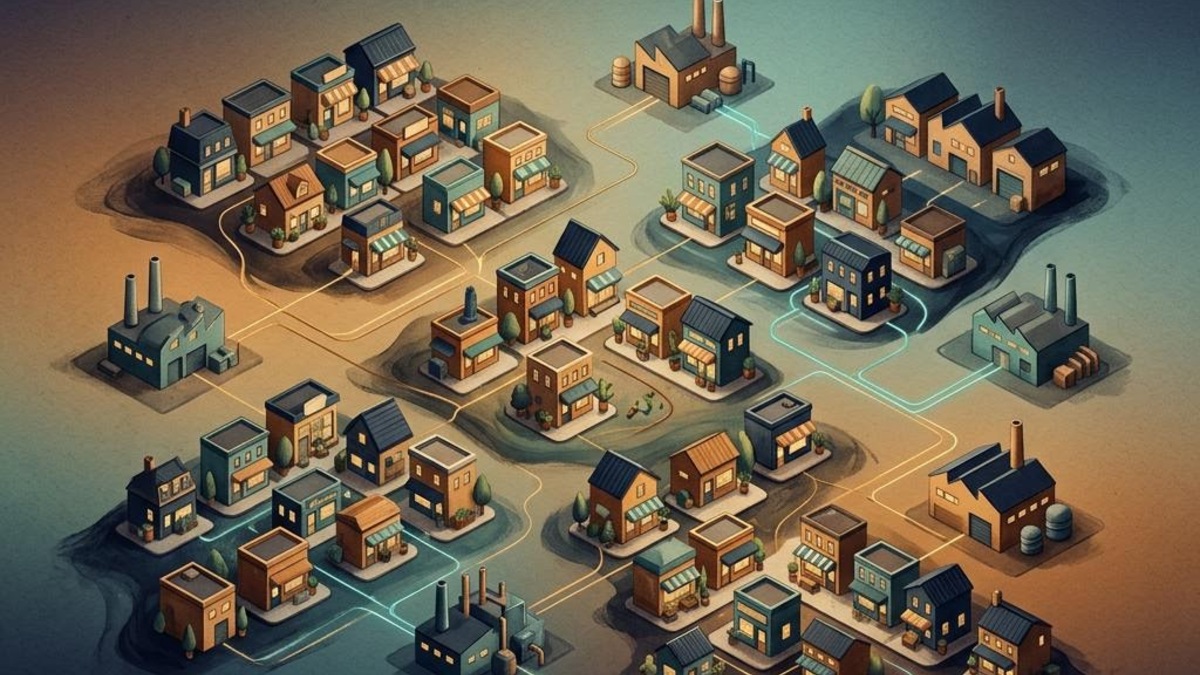
A four-person gun shop in a town of thirty thousand and a manufacturer building eight thousand units a year have almost nothing in common operationally. They have the same problem.
Neither is big enough to matter to the entity sitting between them.
Concentration, and what it actually cost
This is usually asserted rather than shown, so here is the specific history.
AcuSport, a national shooting sports distributor based in Bellefontaine, Ohio, filed Chapter 11 on May 1, 2018 and sold its distribution and IT assets to Ellett Brothers, a subsidiary of United Sporting Companies, for $7.35 million with court approval that June. United Sporting Companies then owned Ellett Brothers, Jerry's Sport Center, and AcuSport. Three national distributors, one corporate parent.
Fourteen months later, on June 10, 2019, United Sporting Companies filed Chapter 11 in Delaware under parent SportCo Holdings. Court filings put its customer base at roughly 20,000 independent retailers across all 50 states.
That is the shape of the risk, and it is more specific than "distribution has consolidated." Consolidation put three distributors under one balance sheet, and when that balance sheet failed, the disruption reached 20,000 dealers at once rather than a third of them. Manufacturers who had routed a large share of volume through that group discovered simultaneously that they had a single point of failure.
The squeeze, from both ends
Concentration is not malicious. It is arithmetic. A buyer managing hundreds of brands cannot give equal attention to all of them, so attention goes to the lines that move volume and generate margin. Everyone else gets a line item and a reorder algorithm.
For the small-to-mid-market manufacturer that produces a familiar set of conditions: terms that assume you need the relationship more than they do, co-op and promotional participation priced as a condition of placement rather than as a measurable investment, line reviews you can be cut in, allocation deprioritization when supply is tight, and no visibility into who is actually buying your product.
For the independent dealer, the mirror image: minimum order quantities calibrated to larger buyers, tier pricing that structurally advantages the volume accounts they compete against, last position in allocation when a product is hot, and no access at all to smaller brands that never made it into the catalog.
The dealer wants interesting product from smaller brands at workable quantities. The manufacturer wants shelf space in independent retail. Both want the same transaction, and the intermediary's economics make it difficult.
Why "just go direct" is not an answer by itself
Manufacturers do sell directly to dealers. It works up to a point and then stops.
On the manufacturer's side, direct dealer business means credit decisions, onboarding paperwork, license verification, order entry, invoicing, collections, and support. At ten dealers that is somebody's part-time job. At three hundred it is a department that costs more than the direct margin produced. This is the real reason manufacturers use distributors even when the spreadsheet looks bad: the distributor absorbs an operational burden that would otherwise require headcount.
On the dealer's side, buying direct from thirty manufacturers means thirty portals, thirty logins, thirty invoice formats. A shop with three employees will not run that. They will buy from two distributors and accept worse terms, because operational simplicity is worth more to them than the margin difference.
That last sentence deserves an honest follow-through, because it undercuts a pitch the rest of this industry makes constantly, including us.
The baseline is two, not thirty
If a dealer's current state is two distributor logins, then a network is not consolidating thirty things into one. It is login number three.
Any vendor telling a small dealer they are about to simplify their life is measuring against a baseline almost no dealer occupies. The distributor already is the one-login, multi-brand order surface. That is precisely why it won.
So the accurate pitch is narrower: add one more surface, and in exchange get access to brands the two distributors cannot give you, at quantities they will not sell you, on terms set by the manufacturer rather than by a buying team. The simplicity argument is not the argument. Access is.
The simplicity argument only becomes real at the margin, and it is a negative one: it is the reason not to add logins four, five, six, and seven. Every manufacturer who hands a dealer their own private portal is adding exactly that. Which brings up the competitor whose entire model is doing so.
The manufacturer-owned portal already exists
The obvious response to everything above is that this describes an ERP, and ERPs exist. That is true, and the usual answer — the functionality is not novel, the delivery model is — is also true but no longer differentiating. Someone in this exact vertical already shipped the delivery-model insight.
Orderwerks sells B2B ordering software to firearms manufacturers and FFL distributors: branded dealer portal, custom catalogs, tiered pricing by account, FastBound integration, serial number tracking, QuickBooks sync instead of an ERP migration. Their firearms page argues directly that you do not need a six-figure ERP quote with a multi-year implementation, and they claim customers scaling from $500K to $7M or more without adding order-processing headcount.
Their positioning is worth reading carefully, because they name the disagreement rather than dodging it. Their pitch is a private portal where customers see only your products, a flat monthly fee with no commission on orders, and the manufacturer owning the customer experience. They contrast that explicitly against a shared marketplace where competitors appear alongside you, a percentage is taken from every order, and the platform sits in the middle of the relationship.
That is a description of the network model, written by someone who thinks it is a bad deal for manufacturers. It is a real argument and it should be answered rather than ignored.
The answer is that this is a genuine tradeoff and the right side depends on what you think is scarce.
The private portal is better for the manufacturer in isolation. Full control of the surface, no per-order fee, no competitor adjacency, no platform in the middle. If you already have the dealer's attention, this is the cheaper and cleaner way to serve it.
The network is better when the dealer's attention is the constraint. The private portal pushes coordination cost onto the dealer, and it scales linearly: every manufacturer who adopts one adds a login to the same three-person shop. That is fine for the tenth-largest brand in a dealer's assortment and unworkable as an industry-wide pattern. A dealer will maintain two or three ordering surfaces. They will not maintain thirty, which is the same constraint that sent them to distributors in the first place.
So the question a manufacturer should ask is not which model is theoretically cleaner. It is whether the dealers you want actually have room for another portal of yours, or whether you need to be somewhere they already are.
Dealer-side aggregation also exists, one layer down
The other thing a knowledgeable reader will think of before finishing this piece: dealers already have multi-source ordering tools.
Gearfire's ecommerce product lets an FFL dealer stream inventory from connected distributors, compare wholesale prices across them, and manage purchase orders from one platform, with connections to twelve distributors including RSR, Sports South, Lipsey's, Davidson's, Zanders, Chattanooga, Bill Hicks, and Camfour. Their platform validates the receiving FFL against ATF eZ Check and routes firearm shipments accordingly. Other platforms in the category do similar things.
This is real infrastructure and it works. Note what it aggregates: distributors. Twelve of them. It is a better front end on the same channel, which means it inherits that channel's assortment. The brands that never made it into a distributor catalog are not in Gearfire either, because Gearfire is reading distributor feeds.
That is the wedge, and it is narrow enough to state precisely. The gap is not multi-source ordering, which exists. The gap is a dealer-side surface that aggregates manufacturers directly, so the small brand that no distributor picked up is reachable at all.
The cold start problem
The obvious objection to any network: it is worthless until both sides are populated, and most B2B marketplaces die there. If you are reading this as an investor rather than a manufacturer, that is the sentence you were waiting for.
The sequencing answer is that the dealer side does not need to be recruited independently. Manufacturers arrive with dealer networks already attached. A brand with two hundred authorized dealers brings those dealers when it connects, because those relationships already exist and the dealers already buy from that brand. The network is seeded vendor-first, and dealer density is a byproduct of vendor onboarding rather than a separate acquisition motion that has to succeed before the first one does.
That is a sequencing plan, not a guarantee. The failure mode it does not eliminate is dealers who connect for one brand and never transact with a second, which would leave a network in name and a set of private portals in practice. The honest position is that vendor-first seeding removes the chicken-and-egg problem, and cross-brand adoption is the thing that still has to be demonstrated.
Why a platform in the middle is not just another intermediary
There is a fair challenge here that any network model has to answer.
The argument against distributor concentration is partly that the intermediary's informational position is what makes it defensible: it sees the transactions, and that visibility is an asset it has reason not to share. A shared network occupies structurally the same seat.
The difference has to be contractual and structural, not rhetorical. The questions a manufacturer should ask any platform, including this one:
- Who owns the order and dealer data, in writing, and what happens to it if you leave?
- Does the platform sell private label or house brands that compete with what it carries?
- Does the platform take a position on which brand a dealer buys, or is discovery neutral?
- Is dealer-level resolution available to the vendor whose product it is, or only in aggregate to the platform?
A distributor's answers to those questions are structurally constrained by its business model. A platform that does not buy, hold title, or compete on assortment can answer them differently. But "can" is not "does," and you should read the agreement rather than the blog post.
What a distributed channel actually buys
A manufacturer routing through two or three large intermediaries has a concentrated channel. USC is what that looks like when it breaks.
A manufacturer with direct relationships across several hundred independent dealers has a more distributed one. Worth being accurate about the size of that benefit: for most brands a direct network is additive at the margin for years, not a replacement for distribution. Several hundred small accounts only de-risk you to the extent they collectively substitute for distributor volume, and early on they do not. The correct claim is that a direct channel reduces the concentration, gives you a relationship that survives a distributor's failure, and gives you data on accounts you otherwise cannot see. It does not make you independent of the channel, and any pitch saying it does is selling you something.
Independent retail is also where product gets recommended. The shop employee who talks a customer through a purchase has more influence over what gets bought than any placement fee, and that employee recommends brands they can get and brands whose reps they know. Access to that layer is worth building infrastructure for, whichever infrastructure you pick.
Concentration in distribution is not going to reverse itself. What is available is a parallel path, built on the coordination cost being carried by shared infrastructure rather than by the smallest party in the transaction.
Oryx connects firearms and outdoor manufacturers to independent dealers through a shared network rather than a portal per brand. If you are weighing that against a private dealer portal, the four questions above are the right ones to ask us.